Forklift attachments are specialised implements that expand a truck’s capabilities beyond simple fork carriage operations, enabling safer, faster and more flexible material handling in busy warehouses. These attachments work by altering the forklift’s interface with loads, for example by extending reach, shifting laterally, or providing clamping and rotation, which directly improves throughput, reduces manual handling and mitigates damage. Warehouse managers and operations leads will learn which attachment categories deliver the greatest productivity gains, how accessories and safety options reduce incidents, and how to choose the right combination for specific layouts and load types. This guide maps essential attachment types, explains technical and safety considerations, and presents a practical decision checklist to help buyers and hirers prioritise investments. It also highlights where local suppliers and hire services can support trials and after-sales support for Sydney warehouses, ensuring readers leave with actionable next steps for selecting and deploying attachments that boost efficiency and safety.
What Are the Key Forklift Attachments for Enhancing Warehouse Efficiency?
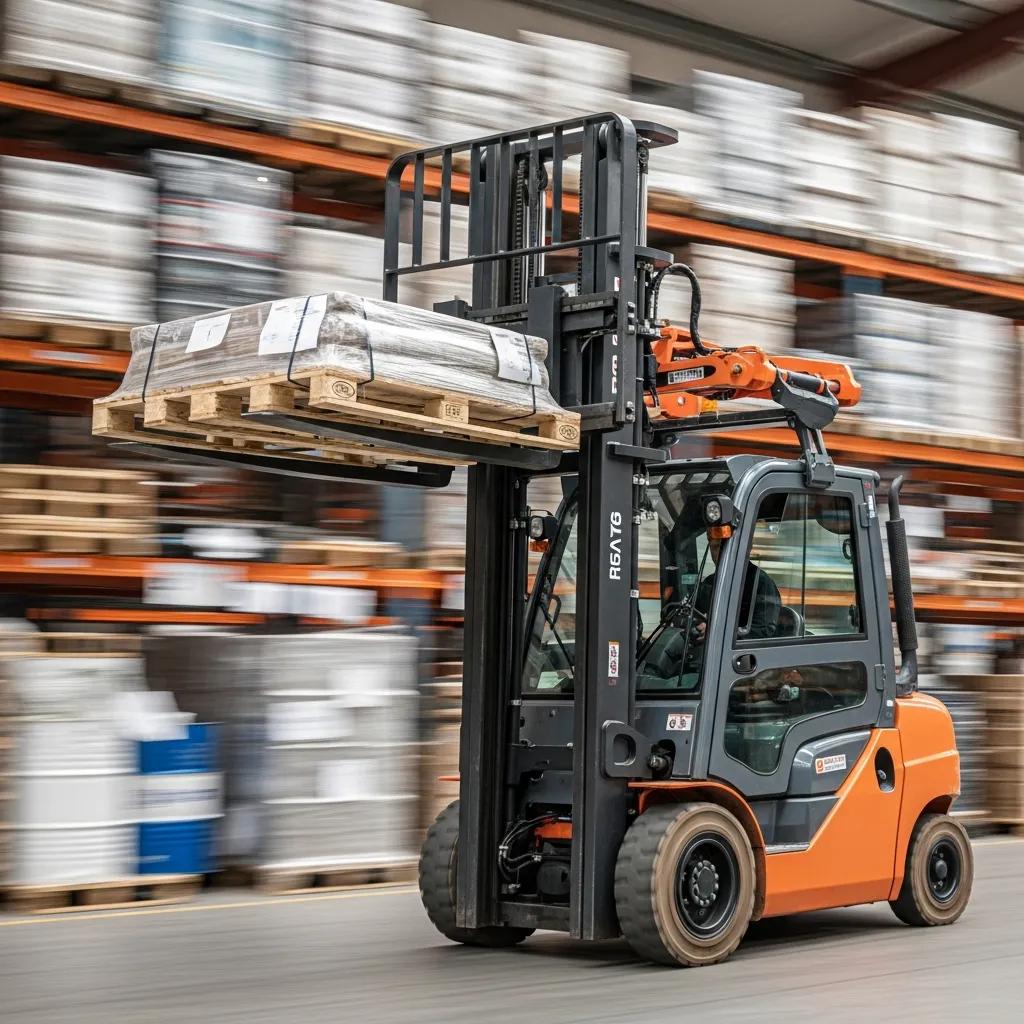
Key forklift attachments convert a standard lift truck into purpose-built material handling equipment that addresses oversized, fragile or irregular loads while improving cycle times and placement accuracy. These high-impact attachments include fork extensions for long loads, side shifters for lateral adjustment, clamp attachments for irregular items, fork positioners to speed spacing changes, and drum handlers for secure barrel movement; each option alters the truck’s interaction with the load and therefore the load centre, handling profile and safety envelope. Choosing the right set of these core attachments reduces repositioning time, minimises product damage and increases throughput at racking and loading bays. Below is a concise list of essential attachments with one-line benefits to aid quick snippet-style decision-making.
Essential attachments and primary efficiency benefits:
-
Fork extensions: Extend reach to stabilise long or bulky loads and reduce overhang damage.
-
Side shifters: Allow lateral fork movement for precise placement without repositioning the truck.
-
Clamp attachments: Secure irregular or soft packaging to eliminate pallet dependency.
-
Fork positioners: Adjust fork spacing hydraulically to speed multi-pallet operations.
-
Drum handlers: Provide secure handling and rotation for barrels to prevent spills.
This compact overview highlights attachments that most directly boost throughput; the following table provides a quick comparison of common load-handling attachments to help match capability to use-case.
Different attachments have distinct dimensions, capacities and ideal use-cases to guide selection and installation.
This comparison clarifies how each attachment alters handling parameters; assessing capacity and compatibility next helps prioritise purchases or hire trials. For warehouses seeking local supply, Mandarin Imports & Exports supplies a wide range of these common attachments and can advise on product compatibility and availability across Sydney suburbs.
How Do Fork Extensions Improve Handling of Oversized Loads?
Fork extensions are purpose-made sleeves or longer blades fitted over standard fork tynes to increase the effective supporting length, which reduces the risk of back-end tipping and prevents load overhang from contacting racking or personnel. By shifting the load support point further forward, extensions change the load centre and therefore require recalculation of rated capacity and adherence to safe working loads; selecting extension length should consider both the longest load handled and the truck’s published capacity curves. Typical applications include timber, ducts, piping and other elongated materials where balanced support across the length prevents bending and product damage. Proper installation and regular inspection for wear, distortion and secure locking mechanisms are essential to maintain safety and predictable lift behaviour, and operators must be briefed on altered lift limits. Understanding these capacity and safety trade-offs prepares managers to select extensions that match both vehicle ratings and the warehouse’s long-load profile.
What Benefits Do Side Shifters Offer for Precise Load Positioning?
Side shifters enable smooth lateral movement of the fork assembly without moving the truck, by using a hydraulic cylinder to shift the carriage left or right; this mechanism reduces the number of repositioning manoeuvres required during racking, loading and truck assembly tasks. The direct benefit is measurable time savings per lift cycle and fewer tight-space manoeuvres, which lowers congestion in narrow aisles and reduces the risk of contact damage to pallets and racking systems. Maintenance is straightforward but requires periodic checks of the hydraulic seals, guide bushings and mounting bracket integrity to prevent drift and ensure accurate lateral travel. Side shifters pair well with fork positioners and laser guides to give precise, repeatable placement; operators trained in combined use can cut average placement time while improving load accuracy in dense storage environments.
Which Specialised Forklift Attachments Optimise Material Handling?
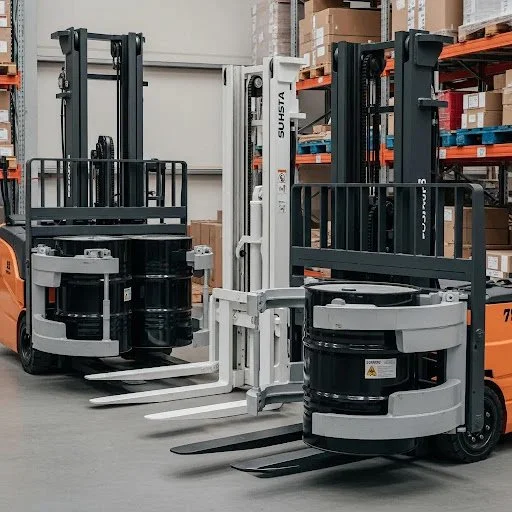
Specialised attachments address industry-specific load profiles where traditional pallet forks are inadequate; these include clamp variants, drum handlers, paper roll clamps, push-pull units and rotators that enable handling of non-palletised, delicate or rotationally sensitive items. Such attachments provide functional traits, grip control, rotation, or controlled squeeze, that prevent product damage and allow single-operator handling of complex loads, which enhances throughput in sectors like manufacturing, paper converting, beverage and stone distribution. When selecting specialised equipment, focus on attachment-specific attributes such as gripping surface, rotation range, hydraulic requirements and carriage compatibility because mismatches can cause unsafe operation or inefficient cycles. The table below summarises technical attributes and compatibility notes for several common specialised attachments to support decision-making.
The following table outlines capacity and compatibility considerations for specialised attachments.
This tabular view helps operations teams align attachment choice with load geometry and truck hydraulic capacity, reducing trial-and-error procurement cycles. Following clamp and drum handling guidance reduces product damage and streamlines load flow in specialised operations.
How Do Clamp Attachments Facilitate Handling of Irregular Items?
Clamp attachments use opposing pads or arms to grip loads securely without pallets, enabling handling of appliances, boxed goods, stone slabs and other irregular shapes that would otherwise require skids or manual handling. The gripping mechanism distributes pressure across contact surfaces to minimise point loading and product marks, and pad material and contact area must be chosen to match the item’s surface finish and fragility. Clamps reduce the need for secondary packing and speed pick-and-place operations in production lines and retail distribution where palletising is inefficient. Selection should consider required gripping force, pad replacement intervals and hydraulic control compatibility to avoid over-compression or slippage. Proper training in speed and squeeze settings prevents product damage while delivering ergonomic benefits by removing manual lifting tasks.
What Are the Uses and Advantages of Drum Handlers and Paper Roll Clamps?
Drum handlers and paper roll clamps offer specialised securement and handling methods that eliminate manual repositioning and mitigate spill or crush risks for cylindrical loads; drum handlers typically cradle or clamp a drum and may include rotation features, while roll clamps engage the cylindrical surface for axial support. In beverage and chemical warehouses, drum handlers prevent spills during transport and allow safe rotation for dispensing, while paper roll clamps protect the core and outer sheet during movement and stacking in converting plants. These attachments improve cycle time by allowing single-step pick, move and place operations, and they reduce damage-related waste and the need for secondary packaging. When integrating these attachments, confirm the drum diameter and roll radius compatibility, and ensure the forklift’s hydraulics and carriage align with the attachment’s mount and flow requirements.
How Can Precision and Speed Be Improved with Forklift Accessories?
Accessories and minor attachments enhance operator accuracy and reduce cycle times by augmenting the truck’s control and guidance systems rather than completely changing its load interface; examples include fork laser guides, fork positioners, back-up blue lights, and load stabilisers that collectively support faster, safer placement. Accessories complement primary attachments by improving alignment, automating repetitive adjustments and providing ergonomic relief for operators who otherwise make manual corrections. Pairing the right accessory with a chosen attachment often yields multiplicative gains, for instance, combining a fork positioner with a side shifter reduces repositioning by both spacing and lateral alignment in a single manoeuvre. Below is a short list of accessories with their functions to guide pairing decisions.
Accessories that improve precision and speed include:
-
Fork laser guides: Provide visual alignment cues to speed pallet engagement and reduce misloads.
-
Fork positioners: Hydraulically set fork spacing to eliminate manual repositioning between pallet types.
-
Back-up blue lights: Alert pedestrians to reversing trucks to reduce near-misses in busy aisles.
-
Load stabilisers: Secure tall or unstable stacks to prevent sway during travel and placement.
These accessories are often low-cost compared to major attachments and yield strong ROI through time savings and reduced incident exposure; the next paragraphs explain fork positioners and laser guides in more detail and how to maintain them.
What Role Do Fork Positioners Play in Adjusting Fork Spacing?
Fork positioners automate fork spacing adjustments using hydraulic control, which reduces downtime between lifts and eliminates manual repositioning that can cause repetitive strain for the operator. There are manual, mechanical and hydraulic/automatic positioners; hydraulic units provide push-button spacing changes from the operator’s seat, making them ideal for high-mix environments with frequent pallet width changes. Investing in positioners is most beneficial when a warehouse handles multiple pallet patterns per shift, as the time saved compounds across hundreds of cycles daily and reduces accidental fork misplacement. Maintenance considerations include checking cylinder seals, hoses and carriage guides for wear, and confirming that carriage mounting remains secure to preserve accurate spacing. Choosing a positioner entails matching its capacity and stroke range to the forklift carriage and average pallet widths encountered in the facility.
How Do Fork Laser Guides Enhance Pallet Alignment Accuracy?
Fork laser guides project visible reference lines onto the pallet or racking to speed alignment, reduce trial insertions and lower the risk of misloads that cause dropped pallets or damaged goods. This guidance technology shortens the alignment learning curve for less-experienced operators and is particularly effective in dimly lit or congested loading areas where visual reference points are limited. Installation and calibration are straightforward but require periodic verification to ensure the laser remains square to the forks and correctly aligned to carriage movement; a basic calibration check should be part of pre-shift inspections. Laser guides work best when paired with operator training and complementary tools such as side shifters or pile guides to ensure both visual and mechanical alignment are optimised.
What Safety and Ergonomic Attachments Are Essential for Warehouses?
Safety and ergonomic attachments reduce risk to people and goods while improving operator comfort and compliance with safe work practices; critical items include gated access platforms for working at height, pedestrian warning systems such as back-up blue lights, and load stabilisers that prevent lateral sway and tip incidents. These devices function as risk-reduction components where standard fork operations would otherwise expose workers to falling loads, near-miss incidents or repetitive strain injuries. Prioritising safety attachments can lower incident frequency and contribute to lower insurance exposure and better staff retention through improved working conditions. The list below highlights must-have safety and ergonomic attachments with one-line benefits to help operations managers form a safety investment plan.
Key safety and ergonomic attachments:
-
Forklift gated access platforms: Provide secure, enclosed platforms for safe work at height and maintenance access.
-
Back-up blue lights: Warn pedestrians when a truck is reversing to reduce near-misses in walkways.
-
Load stabilisers: Prevent sway and shifting during travel when handling tall or uneven stacks.
-
Safety cages and tie-off points: Enable safe attachment of fall-arrest systems when elevating personnel.
After understanding these options, the next subsections detail gated platforms and the combined benefits of blue lights and stabilisers for pedestrian-heavy operations.
How Does a Forklift Gated Access Platform Improve Worker Safety?
A forklift gated access platform converts a lift truck into a controlled working-at-height system by providing enclosed rails, self-closing gates and secure mounting to the carriage, allowing authorised personnel to perform tasks such as inventory checks or light maintenance safely. Design features typically include entry gates, guard rails and anchor points for personal protective equipment, and platforms must be fitted and inspected according to regulatory guidance to ensure stability and safe load ratings. Regular inspection checklists should include platform structural integrity, gate latching mechanisms and carriage mounting points to detect wear or damage before use. Training is essential so operators and platform occupants understand load limits, safe entry/exit procedures and the importance of maintaining the truck stationary and braked during platform use.
What Are the Benefits of Back Up Blue Lights and Load Stabilisers?
Back-up blue lights create a conspicuous visual cue projected ahead of the reversing truck to alert pedestrians to an approaching vehicle, reducing near-miss incidents in busy dock and warehouse zones where audible alarms may be masked by ambient noise. Load stabilisers, such as sway braces or stabilising forks, reduce lateral movement and twisting of tall or uneven loads during transit, which cuts the chance of tipping and associated product loss. Both solutions are straightforward to install and maintain, and they form part of a layered safety strategy that includes operator training, clear pedestrian segregation and daily equipment inspections. Combining visual warning systems with physical stabilisation devices addresses both human-awareness and mechanical stability factors that contribute to workplace incidents.
How to Choose the Right Forklift Attachments for Your Warehouse Operations?
Selecting the right attachments requires a structured assessment of operational factors, because the correct match depends on load type, weight, lift capacity, carriage compatibility and aisle geometry rather than a single “best” attachment. A decision process that assesses needs, trials equipment through hire, and measures ROI before purchase reduces costly mismatches and downtime; the practical steps are assess, match specifications (capacity and load centre), trial or hire the attachment where possible, and then evaluate performance against throughput and safety KPIs. The checklist below condenses key selection factors into actionable items to target for a quick featured-snippet style decision guide.
Checklist for choosing attachments:
-
Assess load types, shapes and weights to define required grip, length and rotation capabilities.
-
Verify forklift carriage, hydraulic flow and rated capacity at adjusted load centres to ensure compatibility.
-
Consider duty cycle and maintenance intervals to select attachments built for expected use frequency.
-
Trial attachments via hire where possible to validate fit and operator ergonomics before purchase.
The table below maps selection factors to practical recommendations to help operations leaders convert assessment findings into specific attachment choices and procurement actions.
Mapping these factors to recommendations simplifies procurement decisions and highlights when hire is preferable to purchase. Mandarin Imports & Exports offers both sales and hire services for attachments, enabling warehouses to trial equipment in their environment and confirm ROI before committing to purchase; leveraging local hire options reduces procurement risk and supports operational verification.
Which Factors Influence the Selection of Forklift Attachments?
Several technical and operational factors directly influence attachment selection: rated capacity and load centre changes, carriage mount compatibility, hydraulic flow and pressure requirements, and expected duty cycle that dictates durability needs and maintenance intervals. Calculating the new effective load centre when an attachment is fitted is critical because capacity can reduce significantly; engineers should consult manufacturer capacity derating charts to ensure safe operation. Compatibility checks must include carriage type and pin spacing as well as hydraulic couplings and flow requirements to prevent mismatches that could render an attachment unusable or unsafe. Factoring these technical elements into the selection process early reduces retrofit surprises and ensures attachments integrate smoothly with existing fleet mechanics and maintenance capabilities.
Understanding the profound impact of attachments on a forklift’s stability and load center is crucial for safe and efficient operations, as highlighted by research in the field.
Forklift Stability & Load Center Impact with Attachments
This study discusses how to design a system to establish the stability of a forklift fork working with different weights using designing and simulation software. The stresses which appear in the lifting installation of a fork-lift truck at loading-unloading operations are investigated for given input data like load carrying capacity of the fork, the effects of various loads on different positions of the fork regarding stresses and then compare calculated Stresses with allowable material stresses (yield stress/F.O.S). This paper focuses on the significance of Load Centre when subjected to loading at different positions.
Impact of shifting load centers on the stability of the forklift, 2018
How Do Warehouse Layout and Load Types Affect Attachment Choice?
Warehouse layout, aisle widths and turning radii determine whether an attachment’s added length or width will impede manoeuvrability, so compact or telescopic solutions are preferred in narrow-aisle contexts while full-length forks or extensions suit open-plan storage. Load geometry dictates functional needs: bulky, stable loads often use extensions or rotators; cylindrical or irregular products demand clamps or dedicated cradles to prevent rolling or slippage. Storage patterns such as double-deep racking may call for telescopic forks or reach-specific attachments to reduce repositioning, and docks with mixed pallet types benefit from fork positioners to speed changes. Conducting a simple layout audit and load catalogue prior to specification will reveal trade-offs and point to optimal attachment classes for safe, efficient handling.
Why Partner with Mandarin Imports & Exports for Forklift Attachments in Sydney?
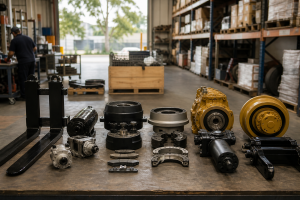
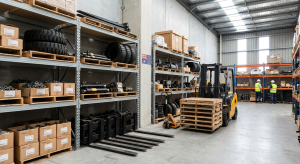
Mandarin Imports & Exports is a Sydney-based supplier of forklift parts and warehouse solutions that offers a broad range of forklift attachments, warehouse equipment and quality spare parts suitable for sale and hire. Their local presence across Sydney suburbs supports faster parts availability and pragmatic after-sales support, while their product range includes common attachments referenced in this guide such as fork tynes, solid tyres and container ramps alongside specialised clamps and handling solutions. For operations seeking reliability and hands-on advice, working with a local supplier can shorten lead times for trial hire, expedite parts replacement and provide timely technical guidance on compatibility and maintenance considerations. Partnering with a supplier that offers both sales and hire options helps warehouses trial attachments in-situ to validate productivity gains before allocating capital expenditure.
Mandarin’s service focus emphasises product reliability, cost efficiency and local accessibility, which are practical benefits for busy Sydney warehouses that require quick turnarounds and dependable after-sales support. Their offering is positioned to help operations match the attachment to the forklift fleet and the facility layout, and to arrange hire trials where managers can measure throughput improvements and safety outcomes directly. Contacting a local supplier to discuss specific application requirements is a pragmatic step after completing the selection checklist and shortlisting candidate attachments.
What Unique Value Does Mandarin Imports & Exports Offer for Warehouse Solutions?
Mandarin Imports & Exports brings a local, Sydney-focused approach to supplying forklift attachments and warehouse equipment, combining an extensive product range with expertise in parts and compatibility to support sales and hire decisions. Their inventory includes common attachment categories and spare parts such as fork tynes and solid tyres, which helps operators consolidate procurement and reduce downtime through local stock availability. This proximity to Sydney’s industrial suburbs enables pragmatic after-sales support and the option to arrange hire for trialling attachments in real operational settings to validate fit and ROI. These practical strengths support warehouse teams that prioritise reliability, durability and cost-efficient solutions in procurement.
How Does Local Accessibility and After-Sales Support Benefit Sydney Warehouses?
Local accessibility means stock and technical expertise are closer to the warehouse, which reduces lead times for replacement parts and shortens delays for service calls, thereby lowering downtime risks during peak operations. Mandarin Imports & Exports’ local service approach supports distribution across Sydney suburbs including Fairfield, Wetherill Park, Auburn, Blacktown, Bankstown, Liverpool and Parramatta, enabling more responsive logistics and service scheduling. After-sales support that covers parts availability, maintenance guidance and hire logistics helps warehouses maintain continuity and quickly resolve compatibility or wear-related issues. For operations aiming to keep fleet uptime high and manage capital wisely, local suppliers and hire services provide an effective bridge between initial selection and long-term operational reliability.
Frequently Asked Questions
What factors should I consider when selecting forklift attachments?
When selecting forklift attachments, consider factors such as load type, weight, and dimensions, as these will dictate the required grip and support capabilities. Additionally, assess the forklift’s rated capacity and how the attachment will affect the load centre. Compatibility with the forklift’s carriage and hydraulic system is crucial to ensure safe operation. Finally, evaluate the expected duty cycle to choose attachments that can withstand the frequency of use, and consider trialing options through hire to validate their effectiveness in your specific environment.
How can I ensure the safety of my forklift attachments?
To ensure the safety of forklift attachments, regular inspections and maintenance are essential. Check for wear and tear, secure mounting, and proper hydraulic function. Operators should be trained on the specific use and limitations of each attachment, including load limits and safe handling practices. Additionally, implementing safety features such as back-up alarms and visual warning systems can help mitigate risks. Following manufacturer guidelines for installation and usage will also contribute to maintaining a safe working environment.
What are the advantages of using hydraulic fork positioners?
Hydraulic fork positioners offer significant advantages by automating the adjustment of fork spacing, which reduces the time spent on manual repositioning. This feature is particularly beneficial in environments with varying pallet sizes, as it allows operators to quickly adapt to different loads without leaving the operator’s seat. This not only enhances efficiency but also reduces the risk of repetitive strain injuries. Regular maintenance of hydraulic systems is necessary to ensure optimal performance and longevity of the positioners.
How do I maintain forklift attachments for optimal performance?
Maintaining forklift attachments involves regular inspections for signs of wear, damage, or misalignment. Key maintenance tasks include checking hydraulic seals, hoses, and connections for leaks, as well as ensuring that all moving parts are lubricated and functioning correctly. Operators should also be trained to identify potential issues during daily checks. Following the manufacturer’s maintenance schedule and guidelines will help prolong the life of the attachments and ensure they operate safely and efficiently.
What types of loads are best suited for specialised forklift attachments?
Specialised forklift attachments are designed for handling non-standard loads that traditional forks cannot manage effectively. These include irregularly shaped items, such as appliances, drums, and paper rolls. Attachments like clamps and drum handlers provide secure gripping and support for these types of loads, preventing damage during transport. When selecting specialised attachments, consider the specific characteristics of the load, such as weight, shape, and fragility, to ensure optimal handling and safety.
Can I trial forklift attachments before purchasing them?
Yes, many suppliers, including Mandarin Imports & Exports, offer trial or hire options for forklift attachments. This allows warehouses to test the equipment in their operational environment before making a purchase. Trialing attachments can help assess their compatibility with existing forklifts, evaluate performance, and determine if they meet specific operational needs. This approach reduces the risk of costly mismatches and ensures that the selected attachments will enhance productivity and safety in your warehouse.