Forklift attachments are specialised devices mounted to a forklift to extend its capabilities on construction sites, enabling safer, faster and more versatile material handling. Understanding which attachments suit particular tasks helps project managers reduce manual handling, speed up workflows and meet site safety obligations. This guide explains the most effective forklift attachments for construction, how they improve safety, which options match common site tasks, and how to choose and maintain attachments for reliable long-term use. Readers will find practical checklists, direct task-to-attachment mappings, maintenance schedules and supplier guidance tailored to construction workflows. Throughout the article we reference core concepts such as load capacity, compatibility, site conditions and operator training, and we show where Sydney-based suppliers can assist with parts, hire and after-sales support. By the end you will have a clear framework to select, operate and maintain attachments that boost productivity while keeping crews safe.
What Are the Most Effective Forklift Attachments for Construction Sites?
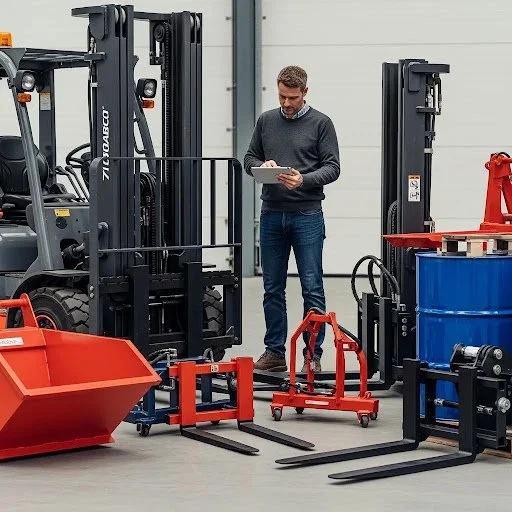
Forklift attachments are specialised tools fitted to a forklift to perform construction-specific tasks by changing the machine’s interface with loads, increasing reach, rotation or containment. They work by redistributing loads, adding mechanical advantage or providing secure fixtures for irregular items, delivering improved productivity and reduced manual handling. Choosing the right set of attachments directly improves site throughput, decreases handling time and reduces the risk of damage to materials. Below is a concise curated list of essential attachments and one-line descriptions to help teams prioritise purchases or hires.
The most essential forklift attachments for construction include:
-
Fork extensions: Increase tine length to stabilise long timber, piping or profiles.
-
Jib crane attachments: Add a lifting hook and swivel for lifting beams and placing items at height.
-
Tipping skips and hoppers: Contain and dump loose material and site waste safely.
-
Side shifters: Allow lateral tine movement for precise placement without repositioning the truck.
-
Work platforms: Provide a secure elevated access platform for personnel with rated gates.
-
Spreader bars: Distribute load when lifting long or flexible structural elements.
-
Drum handlers: Securely lift and transport chemical or lubricant drums with minimal manual contact.
These attachments address the majority of construction handling needs by combining reach, containment and precise placement. Next we examine heavy lifting and material handling attachments in detail to show how they handle specific load types and what considerations operators must observe.
Which Forklift Attachments Enhance Heavy Lifting and Material Handling?
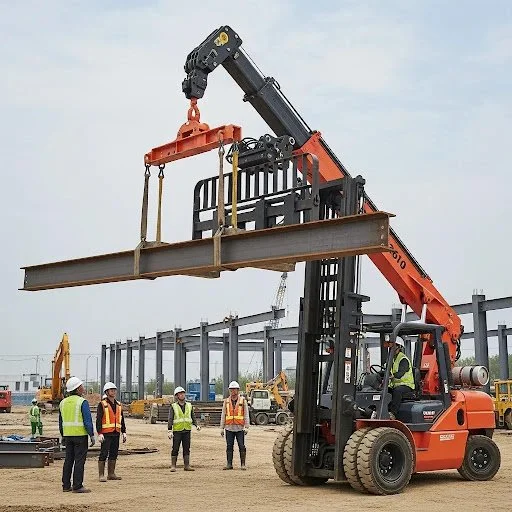
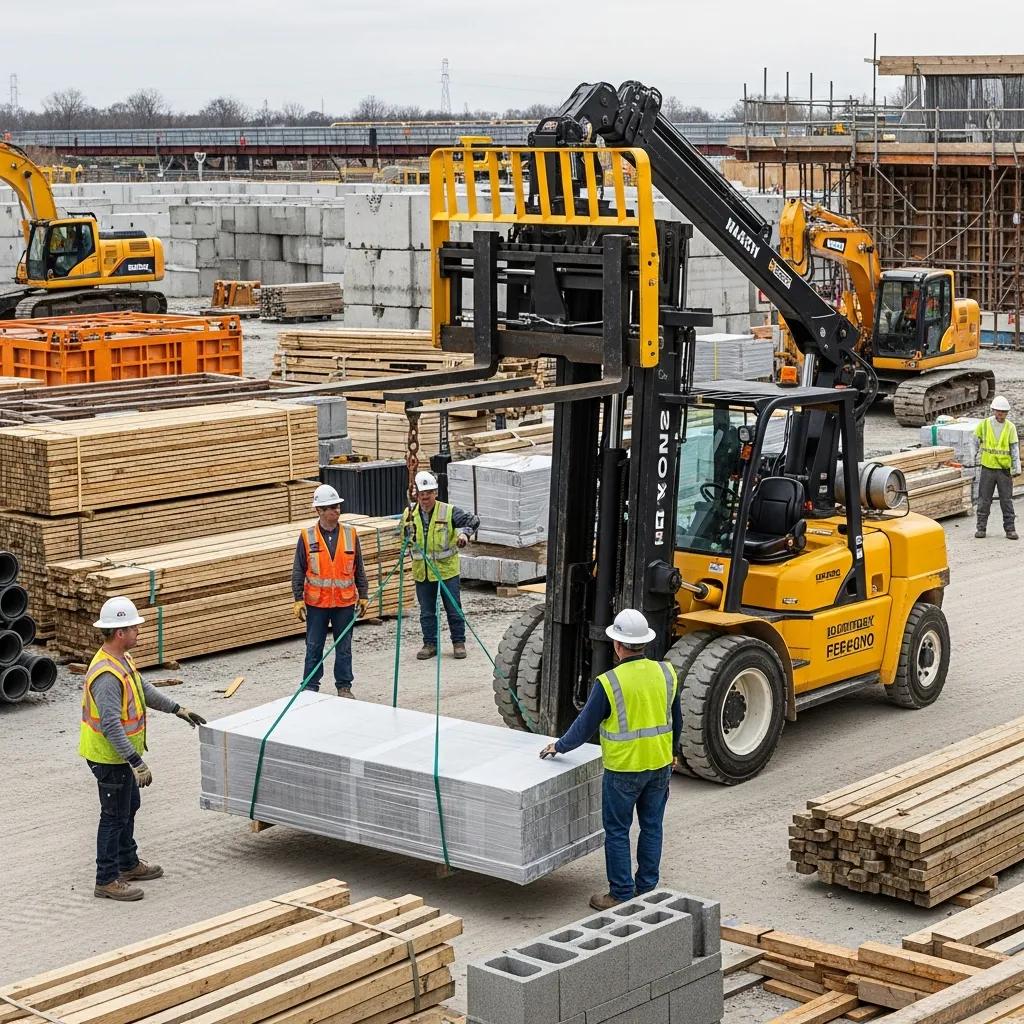
Heavy lifting on construction sites often involves long or unbalanced loads where standard tines are insufficient; attachments such as jib cranes, spreader bars, fork extensions and drum handlers enable forklifts to handle these safely. Jib crane attachments convert a forklift into a short-reach crane with a rated hook and controlled swivel, allowing vertical lifting and fine positioning of beams or equipment. Spreader bars distribute load across multiple lift points to prevent bending or concentrated stresses when lifting long steel, timber or precast elements. Fork extensions stabilise long loads by increasing tine length and support area, reducing tip risk when transporting timber or conduit down site aisles. Drum handlers secure cylindrical loads with clamping or cradle designs, enabling safe transfer of liquids or lubricants without manual hoisting. Operators must factor in the forklift’s load chart with the attachment fitted and apply conservative safety margins; understanding the altered centre of gravity and dynamic load effects is essential to prevent overload and maintain stability.
How Do Attachments Like Fork Extensions and Jib Cranes Improve Construction Operations?
Fork extensions and jib cranes transform routine handling into safer, more efficient operations by extending reach and enabling positional control, which reduces double-handling and manual adjustments. Fork extensions allow crews to pick long lengths that would otherwise require two machines or manual support, simplifying logistics for timber and pipe delivery. Jib cranes enable vertical lifts and small positional adjustments, useful for placing beams, setting trusses or lifting light plant into confined areas where a crane is impractical. The trade-offs are weight and reduced residual capacity: extensions and jibs change the load centre and lower maximum safe loads, so operators must refer to modified load charts and ensure secure mounting. With correct selection and operator training, these attachments streamline workflows by reducing staging time and the need for temporary supports, improving both speed and site ergonomics.
How Do Forklift Attachments Improve Safety on Construction Sites?
Attachments improve safety by enabling secure handling of unusual loads, reducing manual lifting, and providing engineered safeguards for work at height and material containment. By matching attachment type to load geometry and task, teams reduce the likelihood of dropped loads, tipping incidents and manual handling injuries. Many attachments incorporate safety features, locking pins, rated gates, tie-off points and positive securing clamps, that enforce safer handling practices and make compliance with site rules and relevant Australian guidance more straightforward. The next paragraphs break down specific safety features found in common attachments and outline how correct usage translates into measurable reductions in accidents and site damage.
The importance of comprehensive safety protocols and the versatility of forklift attachments are further highlighted in industry guidebooks.
Forklift Attachments, Maintenance & Site Safety
Forklift maintenance companies cannot afford to be without a copy of this guidebook. It is also beneficial in visitors to the site understanding the protocol. Forklifts have an array of attachments which transform the fork of a forklift into a versatile piece of equipment.
A Guidebook of Industrial Traffic Management & Forklift Safety, TJ Larsson, 2003
Work platforms and side shifters include distinct safety features that support compliant elevated work and precise load placement. Work platforms are engineered with guardrails, self-closing gates and designated fall-arrest points to protect personnel when used for access or inspection tasks; they must be used only on forklifts rated for personnel lifts and with manufacturer-specified restraints. Side shifters reduce the need to reposition a forklift repeatedly, lowering exposure to traffic and collision risk by enabling small lateral adjustments from the cab. Both attachment types rely on secure mounting brackets and regular checks of tines/tynes, safety gates and locking mechanisms; inspection points include weld integrity, latch operation and rated-load markings. Understanding these safety features helps supervisors enforce correct protocols and prepare sites for safe attachment operations.
Emphasising the critical need for adherence to safety standards, especially when personnel are elevated, regulatory bodies provide specific guidelines.
Forklift Safety Regulations & Injury Prevention
Hazards for employees working near operating forklifts include being struck by the vehicle and being crushed by the vehicle. When elevating personnel with a forklift, employers should ensure that the platform meets the requirements of 29 CFR 1910.178(m)(12).
Regulating forklift safety: Strategies to prevent injury and improve compliance, 2016
Proper selection and disciplined use of attachments can significantly reduce common worksite accidents such as dropped loads, tip-overs and manual handling injuries by addressing root causes through engineered controls. For example, using a spreader bar rather than lifting a long beam directly from the tines reduces bend and slippage risks, while a tipping skip containing rubble removes the need for manual shovelling and repetitive lifting. Operator responsibilities, adhere to load charts, perform pre-use checks and use tag lines where necessary, combine with maintenance routines to form a system that prevents failures. Linking attachment choice to job planning and toolbox talks ensures crews understand limitations and safe procedures, and referencing local authorities such as Safe Work Australia helps align practices with current regulatory expectations.
Which Forklift Attachments Are Best for Specific Construction Tasks?
Selecting the best attachment depends on the task’s load geometry, site access, and handling frequency; matching attachment capabilities to task requirements reduces handling time and damage. This section maps common construction tasks to recommended attachments and explains the rationale, emphasising pragmatic choices for site supervisors and logistic planners. The table below provides a compact comparison to help choose attachments for lifting steel beams, moving long timber, managing drums and handling site waste.
Below is a quick reference to match common construction tasks with suitable attachments:
This mapping demonstrates how specific attachments match common tasks by addressing stability, containment and precision. Next, the following two subsections explain tipping skip selection and the operational benefits of spreader bars and drum handlers in greater detail.
When Should You Use Tipping Skips and Hoppers for Waste Management?
Tipping skips and hoppers are best used for transporting loose construction waste, small demolition debris and bulk materials that require containment before disposal. Self-dumping hoppers are suited to repetitive waste streams because they allow the operator to position, latch and dump from the cab with minimal manual intervention, improving cycle times for waste handling. Manual or fixed hoppers are better where controlled tipping by ground crews is needed to meet specific disposal protocols or when access to drop points is constrained. Selecting the correct hopper capacity and ensuring the forklift can safely carry the rated load with the centre of gravity shifts are essential; operators should also follow procedures for secure latching and transport to prevent accidental release. These attachments keep sites cleaner, reduce manual handling injuries and streamline transfer to skips or waste trucks when combined with a planned disposal workflow.
What Are the Benefits of Using Spreader Bars and Drum Handlers?
Spreader bars and drum handlers provide engineered load control for awkward or cylindrical items that are difficult to stabilise on standard tines, improving both safety and placement accuracy. Spreader bars transfer load to multiple lift points and reduce bending stress when lifting long beams or precast panels, which lowers the chance of material failure during hoisting. Drum handlers feature secure clamping or cradle systems that prevent rotation and spillage when moving chemical or lubricant drums between storage and point-of-use. Both types reduce the need for manual bracing or additional rigging and are often faster than improvised methods, yielding measurable time savings on repetitive lifts. Regular inspection of securing mechanisms and load-rated shackles is important to maintain the long-term reliability of these specialised attachments.
How to Choose the Right Forklift Attachment for Your Construction Project?
Choosing the right attachment requires a structured assessment of the load, forklift compatibility, site conditions and the intended frequency of use so decisions balance safety, cost and operational effectiveness. A stepwise selection process clarifies needs, narrows options and ensures purchased or hired attachments match the job. The checklist below outlines the core steps teams should follow when selecting attachments for construction work, helping managers make defensible choices that align with technical and budget constraints.
Follow this practical checklist to select the right attachment:
-
Identify the primary load types and sizes you will handle and measure longest lengths and typical weights.
-
Check forklift specifications and altered load charts for each candidate attachment to ensure rated capacity with the attachment fitted.
-
Assess site conditions (ground type, gradients, access width, storage areas) that may affect manoeuvrability and attachment choice.
-
Decide on hire vs buy based on frequency, total cost of ownership and expected maintenance needs, then factor in lead time for parts and service.
After establishing requirements, consult with a supplier or engineer for compatibility checks and formal load rating confirmation. For construction teams needing local support, suppliers in Sydney can offer product hire, parts and compatibility advice to ensure attachments match both forklift carriage class and intended use; scheduling a compatibility check and a quotation is a recommended next step to de-risk procurement. This practical approach ensures selections are safe, cost-effective and aligned with on-site realities.
What Factors Affect Attachment Selection: Load Capacity, Compatibility, and Site Conditions?
Attachment selection hinges on technical compatibility with the forklift and the safety margin required for anticipated loads; load capacity with the attachment fitted is the foremost determining factor. The forklift’s carriage class, fork size and hydraulic connections dictate which attachments can mount safely and operate correctly; attachment mass and altered load centres reduce residual forklift capacity and must be calculated against anticipated loads using manufacturer guidance. Site factors, narrow aisles, soft ground or steep gradients, favour attachments that reduce manoeuvring needs such as side shifters or spreader bars that permit fewer repositioning moves. Rule-of-thumb safety margins, typically 10–25% below the rated capacity to account for dynamic forces, help protect against overloads, but engineers should confirm final numbers with supplier data. Taking these factors together ensures the selected attachment performs reliably within the constraints of both machine and site.
How Does Budget and Frequency of Use Influence Attachment Choice?
Budget and usage frequency determine whether to hire attachments short term or invest in purchase, influencing total cost of ownership and availability for critical tasks. Hiring is cost-effective for infrequent or one-off projects and reduces capital outlay, while purchasing makes sense when an attachment will be used repeatedly across multiple projects and justifies warranty and maintenance investments. Consider residual value and durability when purchasing: heavier-duty, welded constructions cost more upfront but often deliver greater longevity and lower lifetime cost in high-use scenarios. Maintenance expectations and spare parts availability should influence the decision; if parts are hard to source quickly, hiring or selecting alternative designs may reduce downtime risk. A simple ROI calculation comparing hire cost over project duration against purchase plus maintenance gives a pragmatic basis for the procurement decision.
What Are the Best Practices for Maintenance and Safety of Forklift Attachments on Site?
A prescriptive maintenance programme and safety routine keep attachments reliable, compliant and safe to use; these practices include pre-use checks, scheduled servicing and clear removal-from-service criteria. Routine inspections catch wear, corrosion and fastener issues before they lead to failure, while lubrication and load testing maintain mechanical integrity. Record-keeping and certification of repairs preserve traceability for audits and insurance, and ensuring parts availability minimises downtime. Below is a practical EAV table outlining components, maintenance steps and recommended frequencies to help site managers implement a maintainable regime.
Before the table, note that a disciplined approach, daily pre-use checks and scheduled deeper inspections, creates a predictable maintenance rhythm that reduces unexpected failures and supports safe attachment operation.
Which Maintenance Steps Ensure Longevity and Reliability of Attachments?
Longevity depends on scheduled preventive maintenance, correct storage and swift replacement of worn parts before failure occurs; this reduces unplanned downtime and safety risks. Daily pre-use checks should examine mount integrity, safety latches and visible deformation, while weekly checks should verify fastener torque and lubrication status. Monthly or quarterly inspections by a qualified technician should include non-destructive testing of welds and formal load testing where required by site rules or regulatory guidance. Keep spare tines/tynes and common fasteners in stock to ensure quick turnarounds, and document each inspection and repair to maintain an auditable history that supports safe re-commissioning. These practical steps extend service life and keep attachments performing predictably under construction stresses.
How Important Is Operator Training for Safe Attachment Use?
Operator training is essential because attachments alter machine behaviour, require revised load calculations and introduce specific operational checks that only competent personnel can perform reliably. Training should cover attachment-specific load charts, safe mounting and unmounting procedures, pre-use inspection routines and emergency response actions, combined with supervised practical assessments on site. Reassessment intervals and refresher training should be scheduled in accordance with site risk levels and regulatory expectations, ensuring competencies remain current for all operators assigned to attachments. Supervisors should keep training records and tie competence checks to authorisation to operate attachment-equipped forklifts, which enforces accountability and maintains a culture of safety.
The critical role of operator training in mitigating risks and enhancing overall site productivity is underscored by research into forklift safety and efficiency.
Enhancing Forklift Operator Safety & Efficiency
Despite their versatility and importance in warehouse operations, forklifts are also a significant safety concern, with thousands of work-related injuries and fatalities recorded annually. The paper presents findings from a literature review on the factors related to forklift operator safety and efficiency, including energy consumption, training, the Internet of Things, ergonomics, and human factors such as worker fatigue. The study aims to develop a methodological framework to enhance the efficiency and safety of forklift operators by integrating these factors.
Forklift operator safety & productivity: A review of current research and future directions, A Sharptory, 2023
Why Choose Mandarin Imports & Exports for Your Forklift Attachment Needs in Sydney?
Mandarin Imports & Exports is a Sydney-based supplier specialising in forklift parts and comprehensive warehouse solutions, offering a broad range of forklift attachments, warehouse equipment and high-quality spare parts to support construction workflows. The company provides products for sale and hire, giving project teams flexibility to choose purchase or short-term rental based on project duration and budget. Mandarin’s local presence in Sydney supports fast access to essential parts such as fork tynes and tyres and helps minimise downtime through responsive after-sales support and spare parts availability. For construction teams that require durable, cost-efficient solutions and assistance with compatibility checks, Mandarin can provide quotations, hire options and technical guidance to align attachments with specific project requirements.
What Unique Value Does Mandarin Offer in Quality and After-Sales Support?
Mandarin offers reliability and durable products designed for heavy use, combined with cost-efficient solutions and accessible spare parts to keep attachments operational on busy sites. Their product range covers key attachment types relevant to construction, including extensions, skips and specialised handlers, and they support hire as well as sales to match project needs. Fast access to essential parts and after-sales support reduces equipment downtime, while local service in Sydney means logistical responsiveness when parts or advice are needed quickly. For teams seeking both product supply and practical service support, Mandarin positions itself as a single point of contact for attachments, parts and hire options within the Sydney market.
How Have Mandarin’s Attachments Improved Construction Efficiency in Australian Projects?
Mandarin’s attachments and spares reportedly help construction crews improve operational efficiency by reducing manual handling, shortening material transfer cycles and ensuring rapid replacement of worn components to avoid project delays. By offering a mix of sale and hire options, Mandarin enables projects to match procurement decisions to usage patterns, saving capital on short-term needs and supporting long-term operations with durable purchased units. Their focus on fast parts access and after-sales assistance helps teams maintain continuity on site and limits downtime that would otherwise arise from unavailable spares. Project managers who require tailored advice on attachment selection and compatibility can contact Mandarin for consultation and quotations to align attachment choices with project objectives.
-
Inspect requirements: Identify load types, site constraints and frequency of use before selecting attachments.
-
Verify compatibility: Confirm carriage class, fork size and hydraulic connections match the attachment.
-
Plan maintenance: Implement daily checks and scheduled servicing with spare parts on hand.
-
Train operators: Ensure operator training covers attachment-specific handling and emergency procedures.
These practical steps, combined with supplier engagement for compatibility checks and parts provision, establish a robust framework for safe, efficient attachment use on construction sites.
Frequently Asked Questions
What are the key safety features to look for in forklift attachments?
When selecting forklift attachments, it’s crucial to consider safety features that enhance operational security. Look for attachments with locking pins, rated gates, and tie-off points, which help prevent accidental disengagement and ensure secure handling of loads. Additionally, attachments designed for elevated work, like work platforms, should include guardrails and self-closing gates to protect personnel. Regular inspections of these safety features are essential to maintain compliance with safety regulations and to reduce the risk of accidents on construction sites.
How can I ensure the longevity of forklift attachments?
To ensure the longevity of forklift attachments, implement a structured maintenance programme that includes daily pre-use checks and scheduled servicing. Regularly inspect mounting brackets, fasteners, and hydraulic fittings for wear and tear. Lubricate moving parts according to manufacturer guidelines and address any signs of corrosion promptly. Keeping a detailed maintenance log can help track inspections and repairs, ensuring that attachments remain in optimal condition and reducing the likelihood of unexpected failures during operation.
What training is required for operators using forklift attachments?
Operators using forklift attachments must undergo specific training that covers safe mounting and unmounting procedures, attachment-specific load charts, and pre-use inspection routines. Training should also include emergency response actions and practical assessments to ensure competency. Regular refresher courses are recommended to keep skills current, especially as new attachments or technologies are introduced. Maintaining training records is essential for accountability and to ensure that only qualified personnel operate attachment-equipped forklifts safely.
What factors should I consider when hiring versus buying forklift attachments?
When deciding between hiring or buying forklift attachments, consider the frequency of use, budget constraints, and total cost of ownership. Hiring is often more cost-effective for short-term projects, reducing upfront capital expenditure. Conversely, purchasing may be more economical for long-term use, as it allows for warranty benefits and lower maintenance costs over time. Evaluate the expected lifespan of the attachment and the availability of spare parts, as these factors can influence your decision significantly.
How do site conditions affect the choice of forklift attachments?
Site conditions play a critical role in determining the appropriate forklift attachments. Factors such as ground type, gradients, and access width can influence manoeuvrability and the effectiveness of certain attachments. For example, in tight spaces, side shifters may be preferred for precise placement without repositioning the forklift. Additionally, soft or uneven ground may necessitate attachments that enhance stability. Assessing these conditions beforehand ensures that the selected attachments can operate safely and efficiently within the specific site environment.
What are the common mistakes to avoid when using forklift attachments?
Common mistakes when using forklift attachments include failing to consult load charts, neglecting pre-use inspections, and using attachments for unintended purposes. Operators should always verify that the attachment is compatible with the forklift and that the load does not exceed the modified capacity. Additionally, improper mounting or neglecting safety features can lead to accidents. Regular training and adherence to safety protocols are essential to avoid these pitfalls and ensure safe, efficient operation on construction sites.