Choosing the Right Forklift Tynes for Your Needs: The Ultimate Forklift Tyne Selection Guide
Forklift tynes, also called forklift tines or forks, are the load-bearing blades attached to a forklift carriage that lift, carry and stabilise palletised and irregular loads. Choosing the right forklift tynes affects capacity, stability and safety on the warehouse floor, so this guide explains how dimensions, types, materials and inspection regimes determine performance and compliance. You will learn the anatomy of a tyne, how to measure and calculate load centre effects, which specialised tynes match common loads, and how materials influence durability and maintenance. Practical steps and decision aids are included: measurement checklists, EAV tables mapping sizes to typical capacities, and worked examples for load-centre adjustment. Throughout the guide we reference relevant safety practices tied to AS 2359 and show how to verify compatibility with carriage classes and mountings. By the end you’ll have an evidence-based selection process to choose tynes that fit your loads and forklift, plus practical inspection routines to keep them safe and serviceable.
What Are Forklift Tynes and Why Is Choosing the Right One Important?
Forklift tynes are structural blades that transfer load forces from a pallet or object to the forklift carriage and mast, and they directly affect lifting capacity, load stability and workplace safety. The mechanism is straightforward: blade geometry and material determine bending stiffness and heel strength, which in turn control how far the rated capacity remains valid as load centre changes. Selecting incorrect tynes, wrong length, inappropriate width, or unsuitable mounting, creates higher tipping moments, increased wear, and potential failure under load. Understanding this relationship between tyne geometry and operational risk helps reduce accidents and keeps throughput efficient.
Forklift tynes impact operations in three practical ways: they set the usable load envelope, influence operator confidence through stability, and determine maintenance frequency through wear patterns. These operational effects lead naturally into a closer look at the component parts that make up a tyne and how each part contributes to capacity and durability.
Forklift suppliers can simplify selection by offering matched tyne ranges for specific forklifts and loads; Mandarin Imports & Exports, a Sydney-based supplier of forklift parts, stocks a wide selection of forklift tynes, tyres and attachments suitable for common warehouse needs. If you require local availability or expert guidance, a supplier that carries multiple brands and sizes reduces lead time and helps ensure correct fitment; this practical supplier support is particularly useful when matching carriage classes and mountings to a chosen tyne.
What Is the Anatomy of a Forklift Tyne?
A tyne consists of several ergonomic parts, the blade, shank, heel, tip and the mounting hook or bracket, that together determine strength and fit. The blade is the flat lifting surface; its length and width influence load support area and contact pressure, while thickness governs bending resistance. The shank transfers forces into the heel area and affects bending distribution; the heel concentrates shear and contact loads at the carriage interface. Mounting hooks or brackets (mounting type) determine compatibility with carriage classes and must match carriage dimensions to secure the tyne safely.
Each component plays a role in wear and inspection priorities: tips and heels show the first signs of thinning, blades can develop cracks from fatigue, and mounts can deform under misuse. Recognising these parts makes it easier to perform targeted checks and to interpret measurement data when calculating load centre effects, which we explore next.
How Do Forklift Tynes Impact Safety and Efficiency?
Tyne selection influences safety through load stability and the risk of structural failure, and it affects efficiency via handling speed and product protection. A longer tyne increases leverage and can reduce rated capacity at the specified load centre, raising overturn risk if operators do not adjust loads; conversely, the correct tyne reduces damage to goods and avoids frequent job stops for re-rigging.
Operational examples highlight the point: using tapered tynes for fragile cartons reduces damage, while using narrow tynes for wide pallets increases instability. These real-world trade-offs show why dimensional measurement and load-centre calculation are essential steps before choosing tynes.
How Do You Determine the Right Forklift Tyne Dimensions?
Determining the correct tyne dimensions, length, width and thickness, begins with defining the load type, the forklift's rated capacity at its standard load centre, and the carriage mounting interface. The mechanism is rule-based: length affects moment arm and therefore the adjusted capacity, width affects contact pressure and lateral stability, and thickness influences bending stiffness and fatigue life. A clear measurement workflow ensures a safe match between tyne and truck and prevents unexpected de-rating during operations.
Below is a quick reference EAV table that links common tyne sizes and types to their physical attributes and typical use-cases to simplify selection decisions.
| Tyne Size / Type | Length (mm) | Width (mm) | Thickness (mm) | Typical Use / Rated Capacity Indicator |
|---|---|---|---|---|
| Standard 1200 | 1200 | 100 | 40 | General pallets; moderate capacity |
| Long 2400 | 2400 | 125 | 50 | Long loads; requires capacity reduction |
| Tapered 1200 | 1200 | 80 (taper) | 35 | Fragile goods; reduced surface contact |
| Drum Handling 900 | 900 | 150 | 45 | Cylindrical loads; specialised hook fit |
This table clarifies common dimension ranges and their practical implications for load types and handling. Use these baseline values as a starting point and adjust according to your forklift's rated capacity and load-centre calculations.
When measuring a tyne or specifying a replacement, a disciplined checklist avoids costly mistakes and leads to the next step: how to measure accurately for your specific forklift.
What Are Standard Forklift Tyne Sizes and How Do They Affect Load Capacity?
Standard tyne sizes typically range from 900 mm to 2400 mm in length, with common widths of 80–150 mm and thicknesses from 35–50 mm; these dimensions map to expected load capacities and contact behaviour. The reason dimensions matter is mechanical: longer or thinner tynes reduce bending strength and increase deflection, which effectively reduces safe lifting capacity unless the forklift is re-rated. The conventional “10 percent rule” signals that adding tyne length beyond nominal load-centre assumptions often requires recalculating capacity and, in some cases, consulting the truck manufacturer.
Practical examples: a standard 1200 mm tyne on a truck rated at 2,500 kg at a 500 mm load centre will see capacity fall if the load centre moves forward; increasing tyne length to 1800 mm may reduce capacity by several hundred kilograms. Understanding these relationships enables informed trade-offs between reach and rated capacity before purchase.
How to Measure Forklift Tyne Dimensions for Your Specific Forklift Model?
Accurate measurement requires checking both the tyne and the carriage: measure blade length from heel to tip, blade width across the widest section, thickness at a section away from tapered tips, and mounting hook dimensions and spacing. Verify the carriage class stamped on the carriage or refer to the forklift’s specification plate to ensure mounting compatibility, and confirm the hook seating depth and spacing match the replacement tyne. Record the current load-centre used for rating and measure your typical load centre to calculate any de-rating required.
Follow this step-by-step checklist for measurements:
Measure blade length from heel to tip with the tyne installed and unloaded.
Measure width and thickness at standard reference points, avoiding tapered tips.
Verify carriage hook spacing and class markings and confirm seating depth.
Careful measurement prevents mismatches and leads directly into selecting the correct tyne type for the loads you routinely handle.
What Are the Different Types of Forklift Tynes and Their Applications?
Forklift tynes come in several hyponym categories, standard, tapered, drum-handling, coil, telescopic/folding and other specialised types, each designed for different load shapes and operational constraints. The reason different types exist is to match contact geometry and load control to the specific handling need: tapered tynes reduce edge damage, drum tynes clamp or cradle cylindrical loads, and telescopic tynes extend reach without losing rated capacity characteristics. Choosing the right type reduces product damage, improves cycle time and simplifies operator tasks.
Below is an EAV comparison table showing common tyne types, best uses and typical length ranges to help decision-making in practical contexts.
This table helps match a tyne type with common industrial applications and mounting considerations. Use type-specific guides to check compatibility and training needs before switching to specialised attachments.
Which Forklift Tyne Types Are Best for Common Loads?
Different loads need different tyne attributes: pallets are best served by standard flat tynes, fragile cartons benefit from tapered tynes to reduce point pressure, and cylindrical drums require drum-handling attachments or cradle fittings for secure transport. The mechanism behind these matches is contact geometry: more surface area reduces pressure but may snag, while tapered tips ease insertion but can concentrate load at smaller areas. Choosing the appropriate type directly reduces product damage and improves load handling speed.
When deciding, consider examples: food pallets often use coated or food-grade tynes, steel coils require dedicated coil hooks, and construction materials usually benefit from thicker, high-tensile tynes. Practical selection follows from matching load shape, industry constraints and carriage compatibility.
What Specialised Forklift Tynes Are Available for Unique Loads?
Specialised tynes include coil-handling hooks, carpet forks, rotators, and explosion-proof or food-grade variants tailored to specific regulatory and handling constraints. These specialisations exist because some industries need additional features such as hygiene-compliant coatings or intrinsic safety for hazardous environments, and the material handling task demands engineered contact surfaces. Compatibility issues are common with specialised attachments: check counterweight, hydraulic requirements for rotators, and carriage strength for heavier special attachments.
Selecting specialised tynes often requires consultation with a supplier who stocks matching accessories and can confirm fitment and local availability; suppliers that keep diverse inventory reduce lead times for bespoke or industry-specific needs.
Mandarin Imports & Exports supplies a range of tyne types and related attachments suited to warehouse and logistics operations and can advise on matching specialised tynes to common Sydney-area use-cases. Their local stock and parts expertise can speed up fitment checks and support procurement for businesses across Sydney suburbs.
How Do Forklift Tyne Materials and Durability Affect Performance?
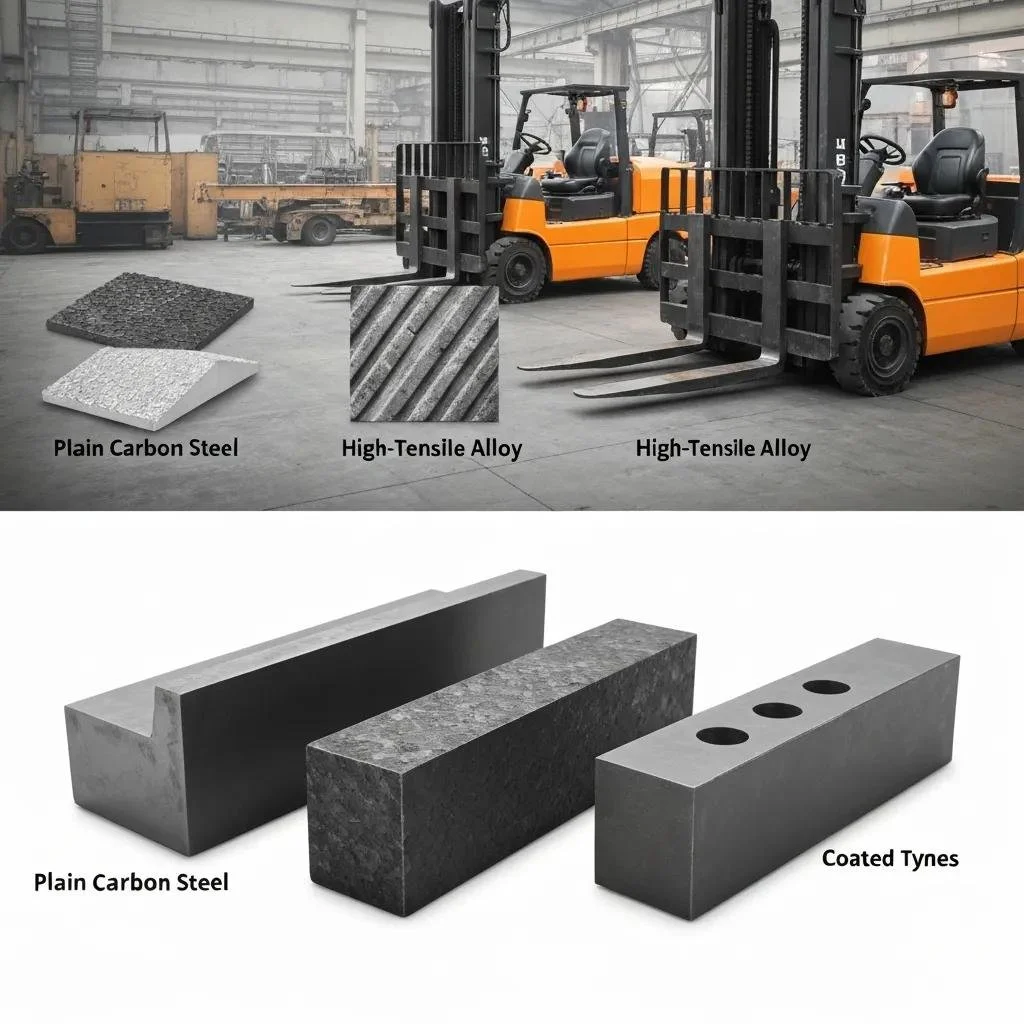
Material choice for tynes, commonly grade steels, heat-treated alloy steels and surface coatings, determines wear rate, impact resistance and maintenance intervals. The mechanism is metallurgical: higher tensile and quenched-and-tempered steels resist bending and fatigue better, while coatings protect against corrosion in humid or wash-down environments. Material selection trades initial cost against life-cycle maintenance and replacement frequency, and that trade-off influences total cost of ownership for your fleet.
Below is an EAV table comparing common materials, expected wear behaviour and practical maintenance considerations to help you weigh pros and cons.
| Material / Finish | Wear Rate | Maintenance Frequency | Pros / Cons |
|---|---|---|---|
| Plain carbon steel | Moderate | Regular inspections monthly | Cost-effective but less fatigue resistance |
| High-tensile alloy | Low | Inspection quarterly | High strength and longer life, higher cost |
| Heat-treated steel | Low | Scheduled professional checks | Best for heavy-duty cycles, needs certified machining |
| Coated / stainless | Very low | Wash-down compatible | Corrosion-resistant for food/chemical use |
This table clarifies how different materials influence operational maintenance and selection priorities. Prioritise material choices according to load cycles and environmental exposure.
What Are the Common Materials Used in Forklift Tynes?
Common materials include medium carbon steels for general use, high-tensile alloy steels for heavy-duty and extended-life tynes, and stainless or coated options for corrosive or hygienic environments. The mechanical reason for choosing higher-grade materials is improved yield strength and fatigue life, which translates to fewer replacements and reduced downtime. Coatings such as powder-coat or galvanising add corrosion resistance but do not substitute for the base material’s structural properties.
Choose material based on load frequency, environmental exposure and budget; the right material choice reduces both maintenance costs and risk of sudden tyne failure, which we detail next.
How Does Material Choice Influence Maintenance and Wear?
Material properties affect where and how quickly wear appears: tips and heels tend to thin first under abrasion, while shanks can show fatigue cracks under repetitive bending. For higher-wear environments, high-tensile or heat-treated steels reduce deformation and slow wear progression, decreasing maintenance frequency and extending intervals between professional inspections. Maintenance actions differ by material: coated steels require surface checks and recoating, whereas high-tensile steels may prioritise crack detection and nondestructive testing.
A practical maintenance plan ties material to inspection cadence: daily operator checks plus periodic professional inspections calibrated to material and duty cycle reduce unexpected failures and support compliance with safety standards discussed next.
What Are the Safety Standards and Inspection Requirements for Forklift Tynes?
Safety standards for lifting components reference Australian and industry practice, with AS 2359-style guidance on safe operation and component testing informing daily, periodic and professional inspections. The mechanism for compliance is tiered: operators perform daily visual checks, maintenance teams execute scheduled dimensional and wear measurements, and qualified technicians carry out thorough assessments and fitment verification. Following a clear inspection schedule reduces risk and ensures tynes are removed from service before critical failure points.
Use the following checklist to structure inspections and compliance activities.
Daily operator checks focus on visible deformation, cracks and secure mounting.
Weekly or monthly maintenance measurements record wear at heel and tip and measure deflection.
Periodic professional inspections include nondestructive testing and dimensional verification against manufacturer limits.
These inspection layers work together to maintain safety and align with AS 2359 obligations, and they lead into specifics on frequency and replacement criteria.
How Often Should Forklift Tynes Be Inspected and Replaced?
A practical inspection schedule separates operator checks from professional inspections: operators should perform daily visual and functional checks, maintenance teams should measure wear monthly or after heavy-duty periods, and professional inspections should occur every 6–12 months depending on duty cycle. Replacement triggers include exceeding wear limits at the tip or heel, visible cracks, permanent bending beyond manufacturer tolerances, or compromised mounting integrity. The reason for staged inspection is risk stratification, frequent visual checks catch obvious problems while periodic detailed inspections detect fatigue and hidden defects.
Apply a conservative replacement threshold: if tip thickness has reduced by more than the manufacturer’s stated limit or deformation is evident, remove the tyne from service and fit a replacement.
These criteria feed directly into a clear daily checklist.
What Are the Key Safety Checks to Perform Daily?
Daily checks should be quick but thorough to catch the most likely failure modes: look for cracks, bends, missing locking pins, loose mountings, and excessive tip wear, and verify free movement of locking mechanisms. Also check for unusual deflection under light loading and ensure tynes are correctly seated and secured on the carriage; these steps prevent immediate hazards during a shift. Document and tag any faults and remove compromised tynes until repaired or replaced.
Mandarin Imports & Exports offers inspection support and replacement parts to help businesses maintain compliance and source correct-fit tynes quickly. Their local presence in Sydney suburbs such as Fairfield, Wetherill Park, Auburn, Blacktown, Bankstown, Liverpool and Parramatta can assist operations needing timely parts or hire options for minimal downtime.
How Do You Choose Forklift Tynes for Specific Loads and Forklift Compatibility?
Choosing tynes for specific loads requires calculating the load centre and adjusting the forklift’s rated capacity accordingly, then verifying carriage class and mounting compatibility so the chosen tyne sits and secures correctly. The mechanism is formulaic: rated capacity reduces as the load centre moves forward, and this change must be calculated and compared with operating needs. A compatibility checklist ensures you don’t fit tynes that are structurally or dimensionally incompatible with the carriage.
Use the following numbered steps to calculate adjusted capacity and verify fitment before purchase or installation.
Identify the forklift’s rated capacity and the standard load centre from the specification plate.
Measure your typical load centre (distance from the fork face to the load’s centre of gravity).
Apply the capacity adjustment formula or consult the truck supplier: adjusted capacity falls as moment arm increases.
These steps create a defensible selection process and lead into a worked example to illustrate calculations.
How to Calculate Forklift Tyne Load Capacity and Load Centre?
Load-centre calculation follows a simple principle: the further the centre of gravity is from the fork face, the greater the moment and the lower the effective capacity. The practical formula compares moments: Rated Capacity × Rated Load Centre = Adjusted Capacity × Actual Load Centre. For example, if a truck is rated at 2,500 kg at 500 mm load centre, moving the load centre to 800 mm reduces adjusted capacity to (2,500 kg × 500 mm) / 800 mm = 1,562.5 kg. This calculation demonstrates why longer tynes or forward-heavy loads can significantly de-rate a truck.
All tynes are engineered to manage a specified load at a predetermined load centre, and provided this load-carrying capacity is adhered to, the profile of the blade section may differ.
Tyne Load Capacity and Design Variations for Forklifts
All tynes are engineered to manage a specified load at a predetermined load centre. Provided this load-carrying capacity is adhered to, the profile of the blade section may differ.
A Guidebook of Industrial Traffic Management & Forklift Safety, TJ Larsson, 2003
Worked examples like this help operations set safe load limits and choose tyne lengths that keep most loads within acceptable capacity without over-reliance on guesswork.
How to Ensure Forklift Tyne Compatibility with Different Forklift Models?
Compatibility hinges on carriage class, mount type and seating depth; verify the carriage class stamped on the carriage and cross-check hook dimensions with the replacement tyne specification. The verification checklist should include measuring hook spacing, seating depth, and confirming the tyne’s rated capacity and material grade match the truck’s intended duty cycle. If adapters or specialised mountings are needed, ensure they are certified and that the combined assembly does not exceed the forklift’s structural limits.
Forklifts are crucial equipment in various industries for the efficient handling and transportation of palletised goods, and a critical component is the fork, which directly interacts with the load and experiences significant stresses during operation.
Optimisation of Fork Design for Forklift Safety and Performance
Forklifts are crucial equipment in various industries for the efficient handling and transportation of palletised goods. A critical forklift component is the fork, which directly interacts with the load and experiences significant stresses during operation. Ensuring the fork's structural integrity and optimising its design are vital for safety, performance, and durability.
Redefining forklift longevity: a study on fork design optimisation and lifecycle enhancement, N Muthuram, 2025
When uncertainties arise, consult a knowledgeable supplier or the forklift manufacturer’s specification sheet to confirm fitment and rating changes, and schedule professional installation to ensure safety and compliance.
Mandarin Imports & Exports can assist businesses with matching tyne specifications to forklift models and provide options for sale or hire, supporting a streamlined path from measurement to fitment across Sydney industrial areas. Their parts range and local presence help reduce downtime when replacements or specialised tynes are required.
Frequently Asked Questions
What factors should I consider when selecting forklift tynes?
When selecting forklift tynes, consider the load type, weight, and dimensions, as well as the forklift's rated capacity and load centre. The tyne's length, width, and thickness directly influence stability and safety. Additionally, assess the material of the tynes, as this affects durability and maintenance needs. Compatibility with the forklift's carriage class and mounting type is crucial to ensure safe operation. Finally, think about the specific application, as different tynes are designed for various load shapes and handling requirements.
How can I ensure the longevity of my forklift tynes?
To ensure the longevity of forklift tynes, implement a regular inspection and maintenance schedule. Daily checks should include visual inspections for cracks, bends, and wear at the tips and heels. Monthly or quarterly professional inspections can help identify fatigue and structural issues. Additionally, choose high-quality materials that resist wear and corrosion, and ensure proper usage according to load specifications. Training operators on correct handling techniques can also reduce unnecessary stress on the tynes, prolonging their lifespan.
What are the consequences of using the wrong forklift tynes?
Using the wrong forklift tynes can lead to several serious consequences, including reduced load stability, increased risk of tipping, and potential structural failure. Incorrectly sized tynes may not support the load adequately, leading to accidents and injuries. Additionally, using inappropriate tynes can cause excessive wear and tear on both the tynes and the forklift, resulting in higher maintenance costs and downtime. Ultimately, this can compromise workplace safety and efficiency, making it crucial to select the right tynes for specific applications.
Are there specific regulations governing forklift tyne safety?
Yes, forklift tyne safety is governed by various regulations, including Australian Standard AS 2359, which outlines safety requirements for powered industrial trucks. These regulations cover aspects such as design, construction, and performance standards for lifting components, including tynes. Compliance with these standards is essential to ensure safe operation and reduce the risk of accidents. Regular inspections and maintenance, as stipulated by these regulations, help ensure that tynes remain in safe working condition throughout their service life.
What should I do if my forklift tynes show signs of wear?
If your forklift tynes show signs of wear, such as thinning at the tips or heels, cracks, or permanent bending, it is crucial to take immediate action. First, remove the tynes from service to prevent potential accidents. Next, assess the extent of the wear and consult the manufacturer's guidelines for replacement criteria. Depending on the severity, you may need to replace the tynes entirely or consider professional inspection and repair. Regular maintenance and timely replacement can help maintain safety and operational efficiency.
How do I choose the right supplier for forklift tynes?
Choosing the right supplier for forklift tynes involves evaluating their range of products, expertise, and customer service. Look for suppliers that offer a wide selection of tynes compatible with various forklift models and load types. It's beneficial to select a supplier with industry experience who can provide expert guidance on tyne selection and compatibility. Additionally, consider their local availability for quick access to parts and support. Reading customer reviews and testimonials can also help gauge the reliability and quality of service provided by the supplier.